



-
The LearningCentral is up and running now. It's time to earn a badge with completion of various programs. Go, explore and see if you are a Go-getter or a Conqueror or both.Read More...10 APR 2023 | 12:15 PM
-
The LearningCentral is up and running now. It's time to earn a badge with completion of various programs. Go, explore and see if you are a Go-getter or a Conqueror or both.Read More...10 APR 2023 | 12:15 PM
-
The LearningCentral is up and running now. It's time to earn a badge with completion of various programs. Go, explore and see if you are a Go-getter or a Conqueror or both.Read More...10 APR 2023 | 12:15 PM
-
The LearningCentral is up and running now. It's time to earn a badge with completion of various programs. Go, explore and see if you are a Go-getter or a Conqueror or both.Read More...10 APR 2023 | 12:15 PM
4 Key Concepts and Principles
Whole + Health + Awareness + Responsibility
1. Gestalt
The German word gestalt has no perfect English translation, but a close approximation is “whole.”
Gestalt therapy is based on gestalt psychology, a discipline of experimental psychology founded in Germany in 1912. Gestalt psychologists argued that human beings perceive entire patterns or configurations, not merely individual components.
This is why when we see a group of dots arranged as a triangle, we see a triangle instead of random dots. Our brains organize information into complete configurations, or gestalts (O’Leary, 2013).
Additionally, the individual is thought of as being involved in a constant construction of gestalts, organizing and reorganizing their experience, searching for patterns and a feeling of wholeness. Gestalt therapy associates feeling whole with feeling alive and connected to one’s own unique experience of existence.
Gestalt therapists apply this philosophy of wholeness to their clients. They believe that a human being cannot be understood by generalizing one part of the self to understand the whole person (O’Leary, 2013). For example, the client cannot be understood solely by their diagnosis, or by one interaction, but must be considered the total of all they are.
2. Health
To understand what it means to be healthy in gestalt therapy, we must first understand the ideas of figure and ground. To illustrate, let’s use an image called the Rubin Vase.
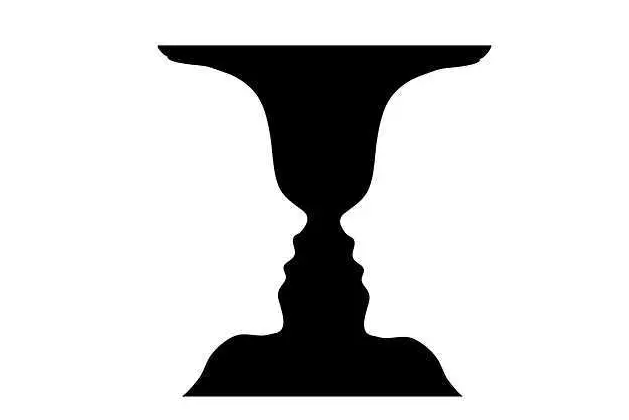
There is a black outline of a vase on the screen, and at first, this is all the viewer notices, but after a moment, the viewer’s attention shifts and they notice the two faces outlined in the white part of the screen, one on either side of the vase.
In the first perception, the black vase is called the figure, and the white faces are called the ground. But the viewer can shift their attention, and through this act, the figure and ground switch, with the white faces becoming the figure, and the black vase the ground.
Gestalt therapists apply this perceptual phenomenon to human experience. Going through the world, we are engaged in a constant process of differentiating figures and grounds. The figure is whatever we are paying attention to, while the ground is whatever is happening in the background. Healthy functioning is the ability to attend flexibly to the figure that is most important at the time (O’Leary, 2013).
Gestalt therapy sees healthy living is a series of creative adjustments (Latner, 1973, p. 54). This means adjusting one’s behavior, naturally and flexibly, to the figure in awareness.
To do this, clients must have an awareness of what is happening to them in the present moment, as well as awareness of their part of the interaction. Increasing this type of awareness, completing past experiences, and encouraging new and flexible behaviors are some of the ways that gestalt therapists help their clients take personal responsibility.